EN
try amma today
Let’s talk about the menstrual cycle
Getting Pregnant

Let’s talk about the menstrual cycle

3 min read
Key takeaways
3 min
  • Track your menstrual cycle starting from day one of your period to better understand your fertility window and recognize pregnancy symptoms.
  • Understand that normal cycles range from 21-35 days, with the average being 28 days and bleeding lasting 1-8 days.
  • Recognize that ovulation occurs mid-cycle (around day 14) when conception is most likely and early pregnancy symptoms may begin.
  • Monitor cycle irregularities as they can indicate anovulatory cycles, especially common in teens and women approaching menopause.
  • Learn the two main phases: follicular phase (pre-ovulation) and luteal phase (post-ovulation) when pregnancy symptoms would first appear.

The menstrual cycle begins on the first day of your period and ends the day before your next period starts. Normal cycles range from 21-35 days (average 28 days) with two main phases: follicular (pre-ovulation) and luteal (post-ovulation), with ovulation occurring mid-cycle when conception is possible.

amma app

Track your pregnancy in the app

Personalized content for your pregnancy week

Download App

The day you get your monthly period is considered the first day of your menstrual cycle; the last day of your cycle is the day before your next period begins. The length of your cycle and the duration of your period are two different things. 

What is the typical length of a menstrual cycle and the duration of a period?

The average cycle is 28 days long. Bleeding will usually last about four days. However, the range of what is considered normal is broad; women can have a cycle that lasts anywhere from 21 to 35 days, and a normal period can last from one to eight days [1].

What are the cycle phases?

The cycle is divided into two phases: before and after ovulation. Ovulation itself is also sometimes described as a separate phase.
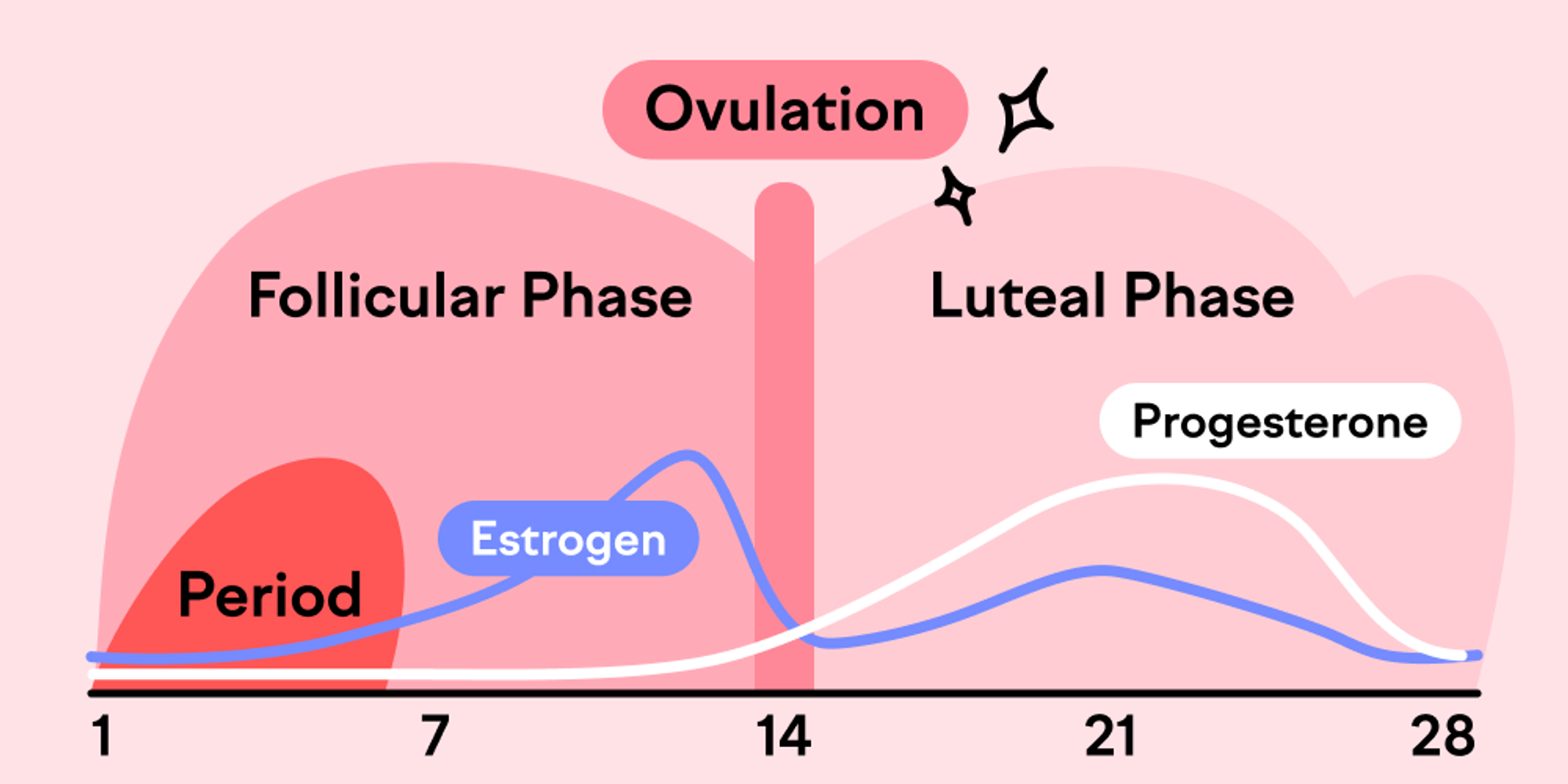
Illustration for Let’s talk about the menstrual cycle

Phases of the menstrual cycle

The first phase is called the follicular phase. It lasts 10 to 16 days, or an average of 14 [2]. It gets its name from the follicle-stimulating hormone (FSH). The pituitary gland produces this hormone and stimulates the growth of follicles in the ovaries. At the same time, under the influence of estrogen, the uterine lining (or endo.metrium) thickens

By the middle of the cycle, an egg cell will mature in one of the follicles, and the luteinizing hormone (LH) is released. The follicle ruptures and the egg cell releases into the abdominal cavity. This is called ovulation, which is when conception can occur. The egg cell then enters the fallopian tube and waits to meet a sperm.
The second phase of the cycle is called the luteal phase. A yellow body, called the corpus luteum, forms in place of the empty follicle. It produces the hormone progesterone, which prepares the uterine lining for embryo implantation. This period typically lasts around 14 days [3]. 

If conception occurs, the level of progesterone will continue to rise. The brain then receives a signal to cease menstruation. If pregnancy does not happen, the corpus luteum stops producing progesterone, and the non-useful mucous layer of the uterus disintegrates and detaches, causing bleeding. This process is observed monthly as another menstruation.

Is it normal for the length of my cycle to vary?

Fluctuations in your cycle of a few days in either direction are normal. But longer, more noticeable fluctuations can be a symptom of an anovulatory cycle. If ovulation does not occur, the yellow body will not form, progesterone levels will not rise, and the cycle is lost. Anovulatory cycles often happen during the first two or three years after menarche (the first menstruation of a woman’s life) and again after age 40, when menopause becomes closer  [1].

Frequently asked questions

Early pregnancy symptoms typically begin 1-2 weeks after conception, which occurs during ovulation around day 14 of your cycle. The first sign is usually a missed period, followed by other symptoms like nausea or breast tenderness.

A normal menstrual cycle ranges from 21 to 35 days, with the average being 28 days. Period bleeding typically lasts 1-8 days, with 4 days being most common.

Ovulation occurs mid-cycle when a mature egg is released from the follicle. This is when conception is most likely to occur, typically around day 14 of a 28-day cycle.

Minor fluctuations of a few days are completely normal. However, significant variations may indicate anovulatory cycles, which are common during the first few years after menarche and approaching menopause.

The menstrual cycle has two main phases: the follicular phase (before ovulation, lasting 10-16 days) and the luteal phase (after ovulation, typically 14 days). Ovulation occurs between these phases when pregnancy can occur.

Medical Disclaimer

This article is for informational purposes only and is not a substitute for professional medical advice, diagnosis, or treatment. Always seek the advice of your physician or qualified health provider with any questions you may have regarding a medical condition.

Meet our medical experts

Medically reviewed content

Reviewed by healthcare professionals · Updated September 2, 2024

Track your pregnancy on the go

Rated 4.8417,594 reviews