EN
try amma today
Which diapers are best for your child?
New Parent

Which diapers are best for your child?

2 min read
Key takeaways
2 min
  • Choose disposable diapers if saving time is your priority - they're ultra-absorbent and require no washing, lasting 2-3 wettings.
  • Select cloth diapers for maximum savings - they're the cheapest option, especially if homemade, versus $1,740 for disposables over two years.
  • Consider reusable waterproof diapers as a middle ground - they cost $10-20 each but last from birth to potty training with proper care.
  • Evaluate environmental impact carefully - all diaper types have drawbacks, from landfill waste to water consumption during manufacturing and washing.
  • Expect to use different diaper types based on circumstances - many parents switch between options depending on their current needs and lifestyle.

The best diaper choice depends on your priorities: disposable diapers offer maximum convenience and time-saving, cloth diapers provide the most cost-effective solution, while reusable waterproof diapers balance durability with moderate environmental impact.

amma app

Track your pregnancy in the app

Personalized content for your pregnancy week

Download App

The debate surrounding disposable diapers hasn't gone away since they were introduced. Thirty years ago, mothers had to choose between cloth and disposable diapers; today, they have to choose between cloth and disposable or reusable waterproof diapers.

Which option you choose will depend on your priorities: affordability, environmental impact, or convenience. It is quite possible that you will use different kinds of diapers depending on the circumstances of your life. Let's solve it together.

Your priority is saving time

I. Disposable ultra-absorbent diapers are the clear winner. For starters, they do not need to be changed every time the baby pees; they remain dry for two to three passes. Second, they do not have to be washed. Simply throw them away.

II. Reusable diapers, especially when used with liners, can also withstand more than one urination. However, there will be a need to schedule time for cleaning the liners and diapers.

III. Cloth diapers should be changed immediately because the baby is moist and unpleasant after peeing. The baby's clothes may also need to be changed. Throughout the day, a large amount of laundry is collected. And you can't leave the house with these diapers.  

Your priority is saving money

I. Cloth diapers, especially if you sew them yourself, are the cheapest option.

II. Reusable diapers are the most expensive. Waterproof diapers, priced between $10 and $20 per piece, are ideal for babies aged 0 to 2 years old and have adjustable snaps. Two packs of six to eight diapers should be adequate for the duration of infancy. 

III. Disposable diapers are sold in large packs. On average, they cost 29 cents each. However, you use approximately 5 to 10 diapers per day. If you used 6,000 diapers in the first two years, it would cost around $1,740.

Your priority is the environment

If every baby uses 8-12 diapers each day, 3.5 million tons of non-degradable trash will end up in landfills each year [1].

However, reusable and cloth diapers need regular washing, the use of synthetic detergents, and, since we're talking about the baby's skin, thorough rinsing — such high water consumption causes virtually as many environmental problems as landfills [1]. Diapers made of cotton, a highly moisture-intensive crop, must also account for the amount of water consumed in the manufacturing process [2].

So we can't decide which type of diapers is the most environmentally friendly.

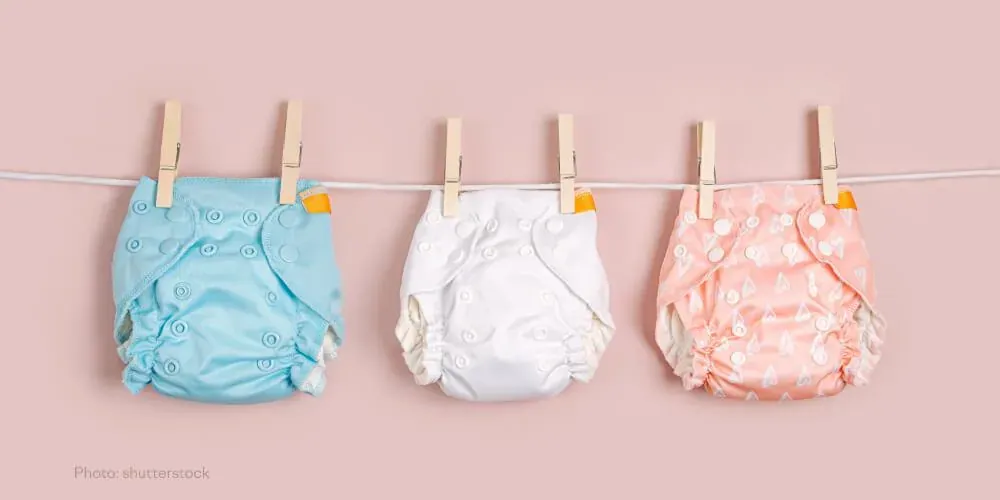
Photo: shutterstock


Frequently asked questions

Cloth diapers are the most cost-effective option, especially if you sew them yourself. Disposable diapers cost approximately $1,740 over the first two years, while reusable waterproof diapers require a higher upfront investment of $10-20 per piece.

Disposable diapers can last 2-3 wettings before changing, while cloth diapers should be changed immediately after each wetting. Reusable diapers with liners can also withstand multiple uses before requiring a change.

Neither option is clearly superior environmentally. Disposable diapers create 3.5 million tons of non-degradable landfill waste annually, while cloth and reusable diapers require significant water consumption for washing and cotton production.

Disposable ultra-absorbent diapers offer the most convenience for time-pressed parents. They require no washing, can be thrown away after use, and don't need changing after every wetting.

Medical Disclaimer

This article is for informational purposes only and is not a substitute for professional medical advice, diagnosis, or treatment. Always seek the advice of your physician or qualified health provider with any questions you may have regarding a medical condition.

Meet our medical experts

Medically reviewed content

Reviewed by healthcare professionals · Updated September 6, 2024

Track your pregnancy on the go

Rated 4.8417,594 reviews