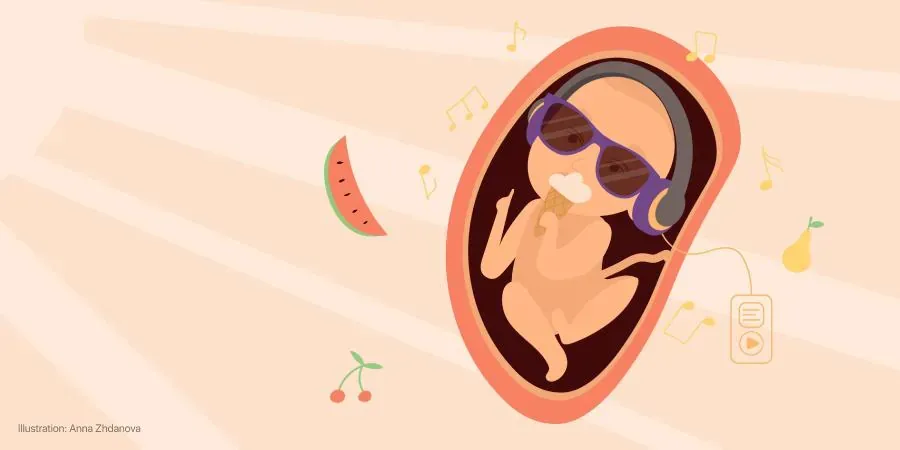

Did you know your baby can already yawn, hiccup, and even cry in the womb [1]? These skills are extremely important for his or her development, but that's not all babies learn during gestation.
1. Listening to voices and music
The abdominal wall mutes the sounds of the surrounding world, but babies still hear muffled noises from the larger world around them. In the uterus, loud noises — such as a freight train — can reach 90 decibels in the womb [2]. But a baby can hear other sounds as well, such as a phone ringing or dog barking. In the 20th week, babies react to loud sounds with reflex movements such as flinching, kicking, or jabbing [3].
In the 36th week, with the maturation of the cochlea (the part of the ear that transmits information about sounds to the brain), babies are able to respond to sounds beyond reflexes [4, 5]. Babies recognize the voices of their parents [6, 7], and newborns will pay attention to the mother's voice when they hear it from afar as it is a familiar sound to them from the uterus.
It’s a great idea to play calm, relaxing music and sing lullabies to babies both in utero and after birth because they can clearly distinguish music [8]. Research shows that after birth, babies recognize songs that were sung to them when they were in their mother's belly. And most importantly, these familiar songs help them calm down and stop crying.
2. Tasting different flavors
Babies’ taste buds are fully formed by week 15. Babies’ first taste sensations are in the stomach, and your diet determines what flavors they will get exposed to. The taste of food is transmitted through the amniotic fluid, which the baby constantly swallows [9]. Also, they can already distinguish bitter from sweet and studies show babies prefer sweet flavours [10]. Researchers have found that an increase in the level of sugar in the amniotic fluid causes the baby to swallow more often [11].
3. Reacting to light
Babies will be able to see fully only after birth, but the visual organs are actively developing throughout pregnancy. The beginnings of the eyes are formed already in the third week of life. By the 28th week, the eyes open, and by the 31st, the pupils begin to respond to light: they narrow when it becomes lighter and expand in the dark [12].
The uterus is far from being pitch black. Baby sees shadow and light with the help of the light-sensitive cells on the retina of the eye. Studies suggest that these cells are critical for the subsequent development of the eyes and visual centers in the brain [12, 13].