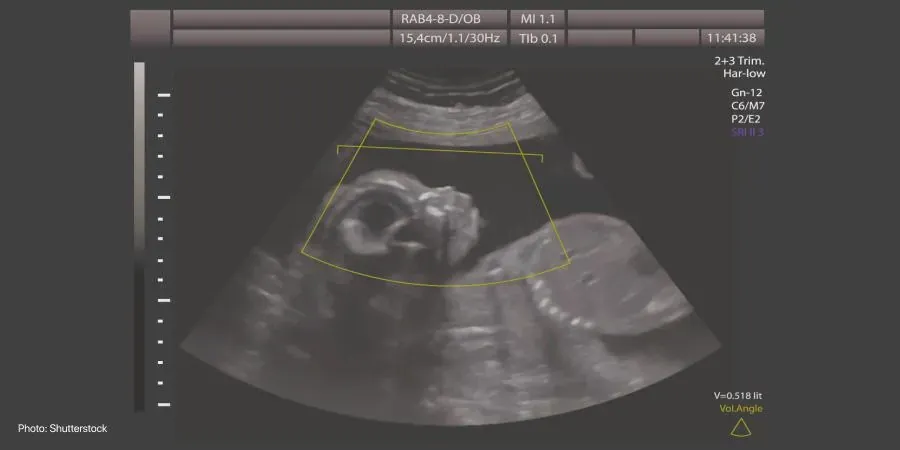

Ultrasound technology is hugely helpful in discovering lots of information about baby and the pregnancy. However, it’s not perfect. One instance where it can be a little off is in determining gestational age and baby’s due date. Most of us know that we can’t expect baby to be born exactly on his due date. Here, we cover some examples of when ultrasound has discrepancies.
I had an ultrasound in my first and second trimesters, and they don’t line up in determining my baby’s gestational age. Which one is right?
The ultrasound in the first trimester is more likely to be correct. Human embryos develop at more or less the same rate, but in the second trimester, when baby’s organ systems are formed, babies can grow differently according to genetics and environmental factors. Your doctor uses baby’s head, abdominal, and hip measurements to determine gestational age, but in the second trimester, healthy babies at the same gestational age can be larger or smaller than average [1].
Furthermore, if the expectant mama is obese or has gestational diabetes, a later ultrasound almost always overestimates baby’s gestational age because of baby’s size. And statistically, baby girls are more likely to have their age overestimated than baby boys [2].
Lastly, ultrasound equipment doesn’t yield perfect images. If there is an earlier ultrasound, it’s usually the one used to determine baby’s gestational age and due date [1].
I didn’t have a first trimester ultrasound. Should I rely on my current ultrasound to determine baby’s due date, or should I go by the date of my last period?
When faced with uncertainty, the more information, the better! It’s not considered very reliable to guess baby’s due date by the date of your last period, especially if that was six or more months ago. But the late ultrasound isn’t necessarily much better, since various factors can influence baby’s size. In this case, your doctor may opt to track baby’s growth rate by having you come in for another ultrasound in two or three weeks [1]. Your doctor will also assess genetic factors that could influence baby’s growth. As an example, a baby with two tall parents is likely to have longer legs.
Your age also matters. Statistically, the biggest discrepancies between the due date determined by last period and the due date determined by ultrasound happen for mothers aged 20-24. Expectant mamas aged 30 and older have much less discrepancy between the two [2].
I had my first trimester ultrasound, and my doctor said baby is “older” than his gestational age. What does that mean?
It’s best to ask your doctor to clarify. Most likely, baby is larger than average for his age, or the placenta shows more development than is expected for your stage of pregnancy.