
You will be meeting your baby in no time! In this review, you will find out what the pregnancy finish line looks like and the best ways to manage everything that’s going on during your last trimester.
Fatigue is building up
At the beginning of the third trimester, the baby has a growth spurt: in five weeks they can gain up to two kilograms — twice as much as in previous months [1]. And your tummy grows right along with them! By the end of pregnancy, it can feel like you are carrying a watermelon in your stomach 24/7. Some unpleasant but natural symptoms may get worse, including the urge to urinate, swelling, back pain, and shortness of breath [2]. It can be exhausting. But the body doesn’t change overnight, and you will have time to adapt. And most importantly, any discomfort will be relatively short-lived, because your due date is fast approaching.
Training contractions appear
Don’t be alarmed if your stomach suddenly tightens noticeably and then relaxes. Unlike real contractions, Braxton-Hicks or practice contractions are mostly random and painless [3]. It’s the way the uterus prepares for childbirth, and the baby learns to respond to external stimuli. If the contractions do not go away even at rest, your stomach hurts or you notice spotting, consult your doctor immediately.
The baby becomes calmer
After the 32nd week, the baby will be pretty cramped inside the womb. At this time, or a bit later, they will more than likely turn upside down, pull their legs up to their chest, and remain in this position until birth [4]. Periodically, the baby will fidget, stretch and toss from side to side, visibly contorting your stomach. But do not expect strong kicks or somersaults, as you experienced at the end of the second or beginning of the third trimester.
Sleeping gets harder
The baby kicks, you get a cramp, and then you need to pee (again!). Studies show that in the last trimester, a third of pregnant women get less than seven hours of sleep [5]. If you feel tired during the day, try taking a mid-morning nap if possible [6]. Consider this practice for the near future, because new parents also have to get up at night and may have to catch up on sleep during the day while the baby naps.
Breasts prepare for lactation
You may notice a yellowish liquid coming from your nipples. This substance is called colostrum, and it is the baby’s first source of nourishment outside the womb; it is packed with nutrients and immunoglobulins. Some moms have so much colostrum that they need breast pads, while others start producing it until childbirth [7].
An urge to get the house ready
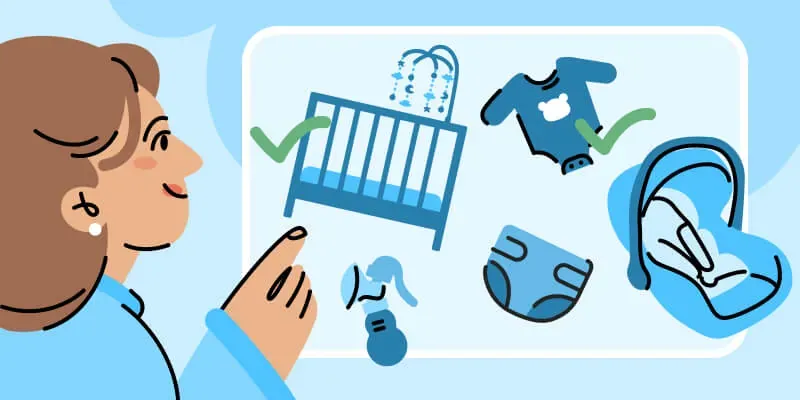
Don’t be surprised if a few weeks before giving birth, you get a surge of energy that has you cleaning the house, rearranging the furniture, and buying all sorts of cute things for the nursery. This behavior signals what is known as nesting syndrome. Some scientists believe that it is programmed by nature, and consider it an instinct that motivates a mother to prepare the space where she will care for her baby [8]. Others are convinced that it is a socially imposed pattern of behavior [9]. Either way, don’t pressure yourself into having a perfect nursery, and refrain from buying every baby item you come across! Try to remain calm, stick to your shopping list, and remember that, by and large, a newborn needs only two things: parental care and nourishment.
Anxiety sets in
"What if suddenly something goes wrong?", "Will the baby be healthy?", "Will I be able to handle the pain of childbirth?". These and other fears are perfectly natural. Three quarters of expectant mothers worry before giving birth, and one in ten faces true phobia [10]. Don’t attempt to ignore your emotions [11]. It is better to talk to a loved one who will listen to you without judgment. Writing down any scary thoughts in a journal in a stream-of-consciousness format can also help you manage anxiety [10].
Labor begins
It's only in the movies that childbirth starts suddenly and dramatically. In real life, the process is slow. First, the cervix will shorten and open slightly, then the mucus plug will come out — it has the appearance of a thick, jelly-like discharge from the vagina. You may experience looser and more frequent bowel movements and lower back pain, and your waters may break (in some cases the doctor will break them during labor). When the real contractions begin, you will more than likely recognize them [12]. Of course, some women deliver quickly, but that is more of an exception, especially if it is a first pregnancy. In most cases, a soon-to-be mom will have enough time to get her bearings and decide if it's time to go to the hospital.