
EN
try amma today
The baby’s face can show expressions
Pregnancy

The baby’s face can show expressions

2 min readWeek 17
Key takeaways
2 min
  • Observe your baby's remarkable facial development as they can now make expressions like frowns and smiles, though movements remain involuntary at this stage.
  • Understand that your baby's eyes can distinguish light from darkness even while closed, responding to bright light from outside the uterus.
  • Expect skeletal development to continue as bones harden and milk teeth form, while all bodily systems improve in structure and function.
  • Know that first-time mothers may not feel baby movements yet, while twin pregnancies may experience earlier movement sensations if babies share one sac.
  • Utilize ultrasound appointments to see detailed baby features including profile, hands with five visible fingers, and positioning within the uterus.

Babies can make facial expressions in the womb including frowns and smiles, though these movements are involuntary. Their eyes can distinguish light from darkness and respond to bright light from outside the uterus, while skeletal development continues with hardening bones and developing teeth.

amma app

Track your pregnancy in the app

Personalized content for your pregnancy week

Download App

The baby’s face can show expressions

The baby’s eyes are now able to distinguish light from darkness. Although they are tightly closed, they can respond to bright light from outside the uterus [1].

They can also make a lot of dramatic facial expressions, including frowns and smiles! But the movements are involuntary since the baby can’t control their facial muscles yet [1].

While awake, the baby can wave, straighten their arms and bend and stretche their legs. But the expectant mom may not be able to feel these movements yet, especially if this is her first pregnancy.

The skeleton continues to ossify, or harden into bone, and milk teeth are developing and covered with dentin tissue.

All bodily systems have developed, and their structure and function continue to improve. The baby continues to grow and gain weight, and by this week they are almost the size of the placenta.

If your partner is expecting twins

The babies are already actively moving their arms and legs, each in their own bubble. But the expectant mother can’t really feel these movements yet, because right now the amount of amniotic fluid is slowly increasing. This allows the babies to grow and get used to the uterus without disturbing each other. Liquid is a very good shock absorber, but if the babies are sharing a single fetal sac, your partner may start feeling the first stirrings.

What we can see on an ultrasound 

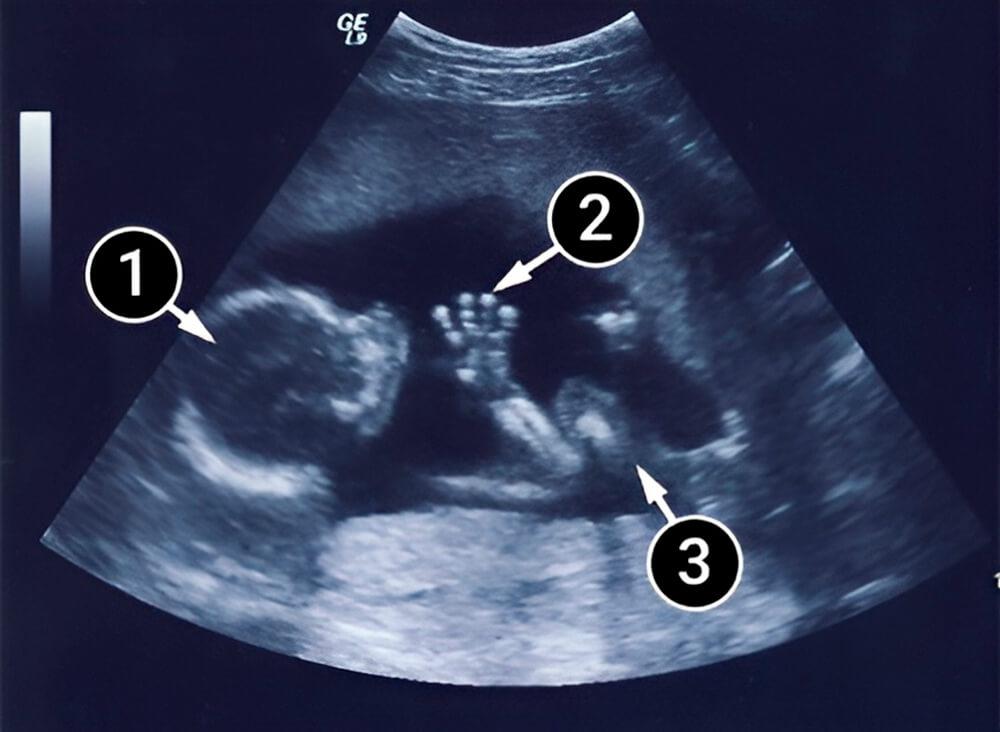
This image shows the baby lying on their back, facing slightly toward us. Their profile is visible, and we can distinguish the forehead, nose, and chin. The right hand seems positioned in a welcome gesture, with the palm, wrist, and five fingers all visible.

The feet are resting against the uterine wall, and the right knee is visible, while the left is mostly obscured.

The baby’s face can show expressions - The baby’s face can show expressions
Frequently asked questions

Babies can make facial expressions including frowns and smiles while in the womb, typically around the second trimester. However, these movements are involuntary since babies cannot yet control their facial muscles at this stage.

Yes, babies can distinguish light from darkness while in the womb, even with their eyes closed. They can respond to bright light that penetrates through the mother's belly and uterine wall.

First-time mothers typically feel baby movements later than experienced mothers, often not until 18-22 weeks. The baby may be moving actively, but increased amniotic fluid acts as a cushion, making movements harder to detect initially.

Ultrasounds can show detailed baby features including facial profile, individual fingers, hand positions, and leg placement. You can often distinguish the forehead, nose, chin, and see how the baby is positioned within the uterus.

Medical Disclaimer

This article is for informational purposes only and is not a substitute for professional medical advice, diagnosis, or treatment. Always seek the advice of your physician or qualified health provider with any questions you may have regarding a medical condition.

Meet our medical experts

Medically reviewed content

Reviewed by healthcare professionals · Updated September 2, 2024

This article is based on peer-reviewed research and trusted medical sources.

  1. Week by week, guide to pregnancy. NHS.

Track your pregnancy on the go

Rated 4.8417,594 reviews