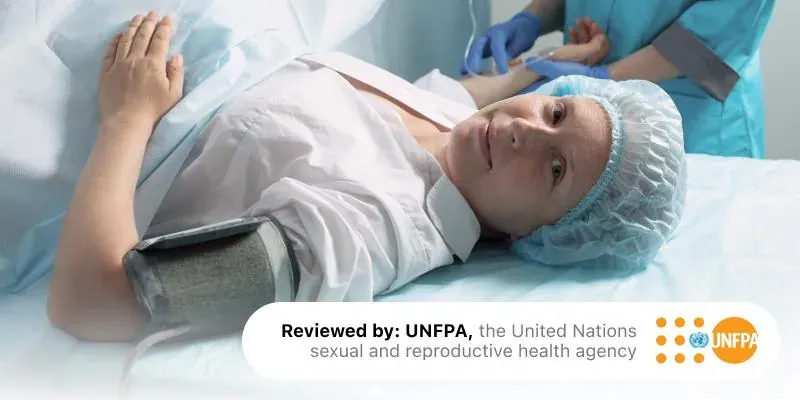

At the beginning of the 21st century, cesarean sections (or C-sections) became somewhat fashionable, as they were often performed for no medical reason and at the request of the mother or the doctor. They were performed because they were faster, easier, and could be scheduled, unlike natural childbirth. But in 2015, the WHO expressed concern about this practice and called for surgery to be used only when necessary.
Why not do a C-section if it's faster and easier?
Because, like any surgery, C-sections often lead to complications, and they are an option only when natural childbirth puts the mother or child at risk.
Quite often, women choose a C-section for fear of childbirth (known as tocophobia). Around the globe, about 14 percent of women experience it, and up to seven percent experience an extreme fear of labor [1, 2]. Most scientists agree that in such cases, psychotherapy is much more effective and safer than surgery “on demand”.
What are the risks of a C-section?
Risks are divided into two categories — early and delayed. The early ones arise during or immediately after the operation and occur in about 14.5 percent of cases.
Early risks include:
wound infections (most common);
endometritis (inflammation of the inner lining of the uterus);
internal bleeding;
hematoma of the bladder (small hematomas occur at every second C-section and are considered normal, but a hematoma larger than five centimeters can lead to rupture of the uterus or sepsis);
rupture of the uterus.
Delayed risks can develop years after the surgery. Researchers are still trying to understand more about delayed complications because if side effects appear years later, a causal relation is difficult to establish. According to various sources, the scar defect, for example, manifests in 20–88% of women who undergo a C-section [3].
Delayed risks include:
scar defect (opening or thinning of the wound);
endometriosis (when, during the operation, the endometrial cells reach other organs, "take root" and grow);
pelvic vein thrombosis;
prolonged menstrual bleeding (up to 12 days);
rupture of the uterus in subsequent pregnancies;
increased likelihood of placental abruption or ingrowth in subsequent pregnancies [3].
What's best for the child?
There are situations where a C-section is better, including:
if the baby is very large;
if the baby is experiencing oxygen starvation;
if the baby is breech and simply cannot come out naturally;
if the mother has an infection that can be transmitted to the baby during childbirth.
However, if these indications are not present, a vaginal birth is considered best for both mother and baby. Babies born via C-section are more likely to have respiratory system issues. Delayed complications in children are also being studied, but the evidence is sparse.
What are other reasons to consider a C-section over vaginal birth
placenta previa;
premature placental abruption;
previous operations on the uterus (two or more C-sections, one C-section, and removal of fibroids, surgery for malformations of the uterus);
incorrect presentation of the child;
multiple pregnancy (especially if one of the babies is in the wrong position);
pregnancy over 41 weeks with no signs of labor;
mother has a very narrow pelvis;
deformities of the cervix and vagina (due to surgery or tumors);
issues with the mother’s health that prevent her from pushing.
In all of the above cases, your doctor will discuss your options with you and schedule a C-section at the appropriate time.
There has been no safer time to give birth than the present. So, if your doctor recommends a C-section, consider that it is probably the safest and best option for your particular case and has no bearing on your capabilities as a mother and a woman or on the bond you have with your baby.