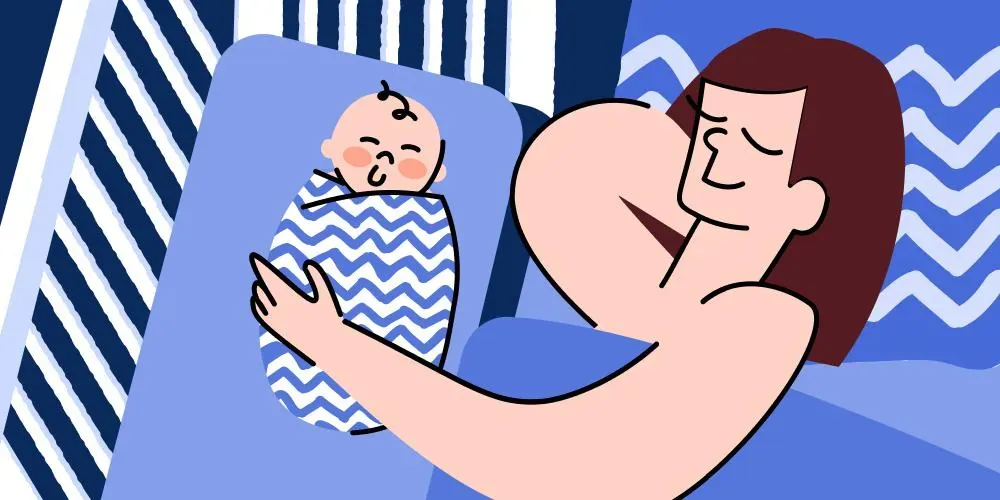

There is no single correct answer to the question of whether parents should sleep with their babies.
What does science say about co-sleeping?
Sleeping with their parents is more natural from an evolutionary standpoint. Babies prefer not to be alone because it causes stress. People used to live in extended families, and babies were constantly watched. The world has become safer, with baby monitors and cribs, but newborns' brains continue to function the same way [1].
Babies have greater physical contact when they sleep with their parents. Regular touching enhances a baby's general health and fosters attachment. Pain decreases, blood glucose levels, body temperature, and the functioning of the cardiovascular and respiratory systems all stabilize [2].
Sleeping with parents, however, carries some risk. Our ability to control our own body movements ends when we go asleep. This puts the infant at risk for suffocation and bed falls [2].
You would benefit more from co-sleeping if:
You find it difficult to get up at night to feed. When you and your baby share a bed, feedings can take place while you are both sleeping, reducing stress.
Physically, you feel at ease with the baby, their presence does not disturb your sleep.
You feel like you need to be with your baby all the time. That being said, sleeping together probably won't help if you are overly anxious. Rather, you will grow weary of listening for the baby all the time. If this sounds like you, you should sleep apart for at least some of the night [3].
Things to keep in mind when choosing co-sleeping
Placing a baby on the bed is not inherently safe. The best solution is an add-on cradle or positioner that fixes baby’s position.
If you are not using these devices (which is strongly encouraged), then keep your baby close to you. Use a bed guardrail or put the bed up against the wall. Make sure there is no open space between the wall and the mattress, as the baby could fall into the crack.
Ensure that your bed is sturdy, adequately large, and not overly soft. If not, the infant faces the danger of falling face down into the mattress's indentations caused by body weight. A baby's neck muscles are still too weak to lift their head off a soft surface.
You would be better off sleeping separately if:
A baby sleeping close to you or your partner causes physical discomfort.
You are extremely concerned about the baby's well-being and health, you are constantly listening, and you are frightened of harming him.
You're not being selfish when you choose to sleep apart; rather, it's a self-care strategy to ensure that you receive enough rest. You can better care for your child during the day once you've regained your strength [3].
Things to keep in mind when choosing a separate sleep
Babies wake up multiple times throughout the night. Divide the night in two parts and organize shifts to keep the baby from waking both of you [4].
Is it possible to find a middle ground between these two solutions?
Absolutely. One possible option is to spend some of the night in bed with your child and the other part of the night leaving the baby in a crib in the same room. This is a sensible choice because it eliminates the dangers associated with sharing a bed while still giving the infant the impression that you are nearby [3].
Photo: shutterstock