
The baby alternates between sleep and wakefulness
By this week, circadian rhythms start to influence the baby. At certain times they will be very active, while at others they become calmer.
 But your baby's daily routine may not match yours, so don't be surprised if they start turning over in the evening and at night when you’re ready to go to bed [1]. At this stage, a baby that is awake can be quite active, they can swallow amniotic fluid, suck a toe and push their legs.
Outwardly, your baby is also changing. Babies develop eyebrows and body hair, and a layer of brown fat forms to help with thermoregulation [2]. In boys, testicles begin to descend.
If you are expecting twins
If you’re carrying fraternal twins (each has its own placenta and its own fetal sac), then their sleep and wake schedules may not coincide. And they are definitely not going to adapt to mom's. So it is possible that you will feel the children's movements non-stop.
What can be seen on the ultrasound
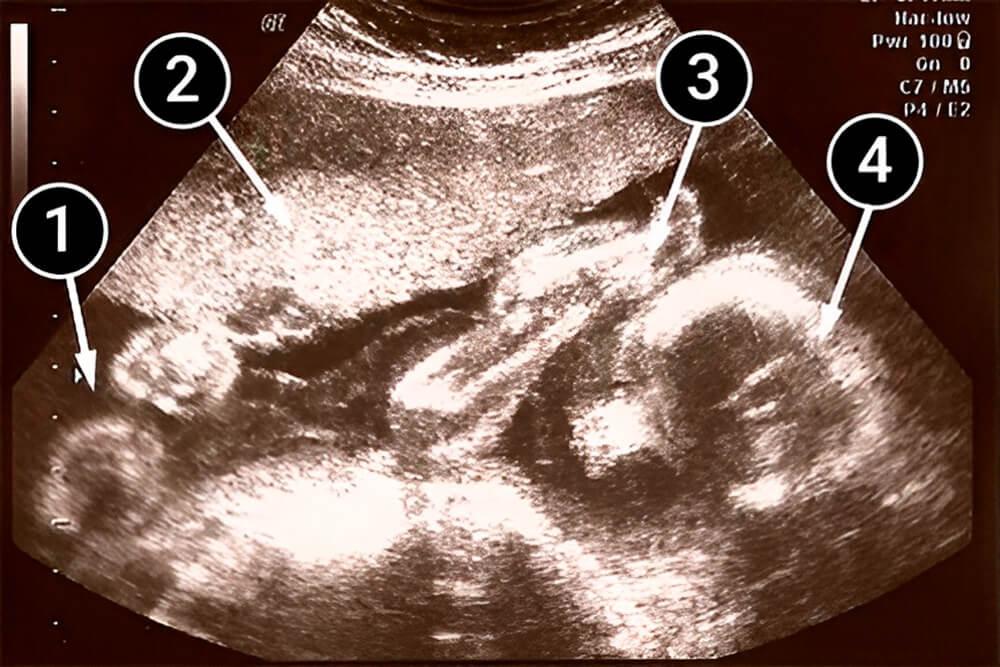
The baby is lying on the left side, facing the screen. This position allows you to see the outline of the face, including the nose and eyes. A thin layer of fine, fluffy hair, called lanugo, is visible on the head.
Both of the baby’s hands are near the right ear, this posture suggests they are asleep.
The light spots on the left side of the image are the legs and knees. The placenta is visible at the top of the photo.