
In the United States, some birthing centers and hospitals offer water births. Let’s see what the benefits and risks are.
What is a water birth?
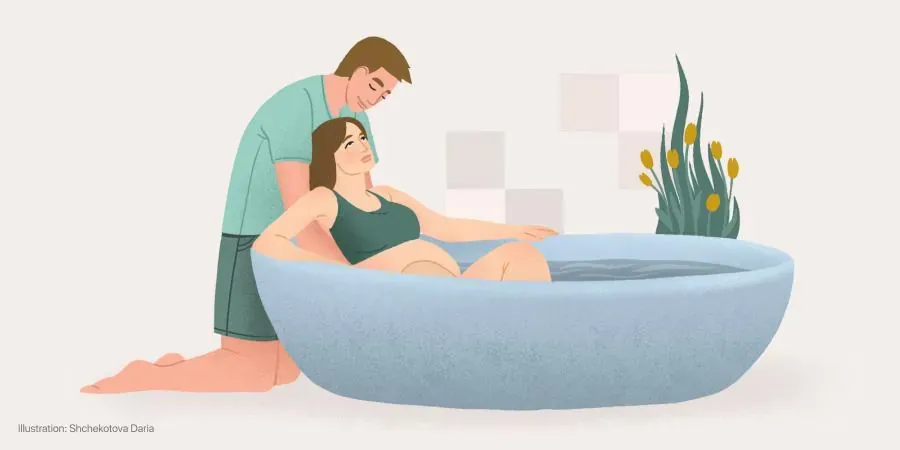
This practice involves going through part or the entirety of labor in a special birthing pool filled with warm water, assisted by a doctor, nurse, or midwife. This takes place in a sterile environment, whether at home, a hospital, or a birthing center. The water has a temperature between 97 and 100 degrees Fahrenheit [1] and has no special chemicals or additives [2].
The use of birthing pools was popularized by French surgeon Michel Odent, whose 1983 article in The Lancet, a well-respected medical journal, brought water births to the mainstream. Odent did not advise water births for everyone but promoted its observed benefits like shortened labor, reduced pain, and fewer inhibitions [2].
Is it safe?
Most women who choose a water birth feel the greatest benefits in the first stage of labor, from the start of contractions to when the cervix is fully dilated. The American College of Obstetricians and Gynecologists (ACOG) supports the use of a birthing pool in the first stage but does not recommend giving birth underwater [3].
In 2024, extensive research was published on the subject, and according to the authors' findings, water births can lower the likelihood of several issues, including maternal bleeding, low Apgar scores, neonatal infections, etc. However, it was noted that the risk of umbilical cord rupture increases significantly [4].
What are the benefits of a water birth?
Many mothers in labor feel more comfortable floating in warm water than lying in bed. The benefits of a water birth include [1, 2]:
quicker cervical dilation;
less vaginal tearing and risk of infection for the mother;
shorter labor;
less use of drugs and anesthesia;
reduced anxiety and added relaxation in the water;
reduced pain, including lumbar or similar musculoskeletal stress pain;
more freedom of movement and the ability to stand, float, or sit as desired.
Odent wrote: “We believe that the warm pool facilitates the first stage of labor because of the reduction of the secretion of nor-adrenaline and other catecholamines; the reduction of sensory stimulation when the ears are underwater; the reduction of the effects of gravity; the alteration of nervous conduction; the direct muscular stretching action; and peripheral vascular action” [2].
Who is a good candidate for a water birth?
Women who are healthy and under the age of 35 are generally good candidates for a water birth. Those who have an infection, preeclampsia, or diabetes are advised not to choose this option. In addition, those expecting twins or other multiples, or those whose baby is in a breech position, are at greater risk of complications since they may need a C-section or other medical intervention; it is vital not to lose precious time by having to leave the birthing pool in an emergency [1].
* This article, titled "Four questions about water birth”, from the AMMA Pregnancy Calendar reflects a naturopathic point of view regarding pregnancy and childbirth management. The information contained in it does not relate to evidence-based medicine and is not supported by research data.